
You log into Google Search Console on a Monday morning. Your highest-converting commercial keyword is still sitting comfortably at position #2. Yet when you toggle over to Google Analytics, qualified organic search traffic to that landing page has plummeted by 35% month-over-month.
No Google manual action or algorithmic penalty struck your domain. Your Core Web Vitals pass with flying colors. Your primary competitors did not surpass you in the standard ten organic blue links.
So what happened to your organic pipeline? Google rolled out an AI Overview directly above your listing.
“Instead of clicking through to review your software guide, high-intent prospects read an AI-synthesized answer at the very top of their viewport, discovered the exact criteria they needed, and closed their browser tab without ever loading your website. Welcome to the zero-click search reality.”
Holding rank #1 on classical search engine result pages (SERPs) is no longer a defensive moat. To safeguard inbound pipeline and acquire qualified enterprise buyers, B2B software and service organizations must transition from pure Search Engine Optimization to Generative Engine Optimization (GEO).
Table of Contents
- The Traffic Drop: Understanding the Zero-Click Shift
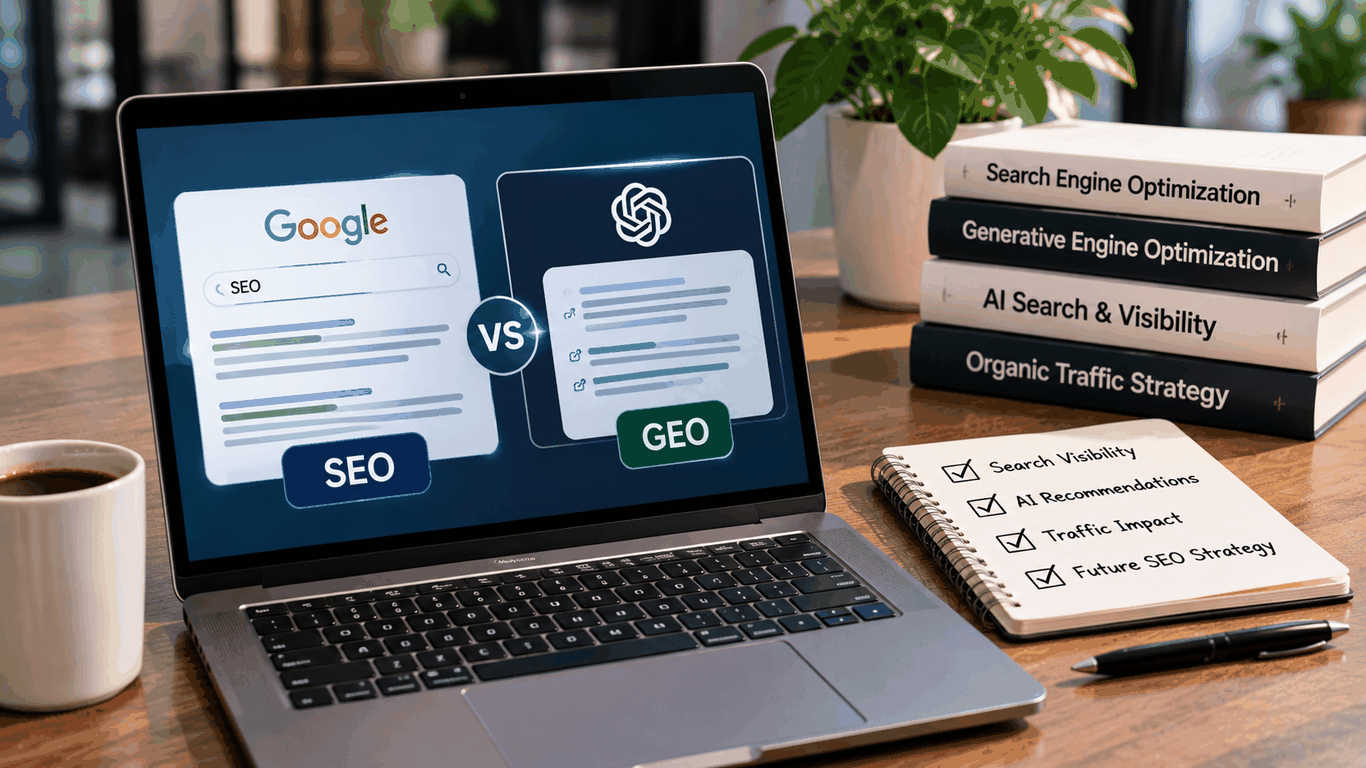
- Head-to-Head Comparison: Traditional SEO vs. GEO
- How AI Engines Actually Decide Which Brands to Cite
- Does GEO Mean Traditional SEO Is Dead? The Compounding Moat
- The Dual-Track Framework: 4 Strategic Moves to Make Today
- Enterprise Playbook: Measuring AI Share of Voice (AI SOV)
- Frequently Asked Questions About SEO vs. GEO
- Conclusion: Future-Proofing Organic Growth in 2026 and Beyond
1. The Traffic Drop: Understanding the Zero-Click Shift
To diagnose why conventional search playbooks are losing their defensive power, one must analyze how buyer discovery behavior has transformed across the last eighteen months. Historically, Google operated under the behavioral architecture of a digital index librarian. When a user submitted a search query, the librarian guided them to the correct section, presented ten relevant books on the shelf, and invited the user to open and read them. Every content creator had an equitable shot at capturing click-through attention.
Modern generative search platforms no longer behave like librarians. They act as research synthesis analysts.
When an executive queries Google AI Overviews, Perplexity, or ChatGPT Search, the underlying Retrieval-Augmented Generation (RAG) architecture reads dozens of web pages in milliseconds, strips away formatting, cross-references factual claims, synthesizes a comprehensive response in natural prose, and serves the conclusion directly on the search results interface. The user receives immediate utility—while the original content creators experience a zero-click abandonment.
Organic CTR Compression
Average click-through drop observed on informational queries where Google AI Overviews occupy the top screen viewport.
Query Complexity Growth
Increase in average prompt word length as business buyers switch from keyword fragments to multi-constraint conversational questions.
AI Referral Intent
Conversion rate premium exhibited by visitors arriving via conversational AI citations compared to conventional organic search visitors.
This paradigm shift exposes three irreversible market dynamics:
- AI Overviews Dominate Viewport Real Estate: On mobile devices and laptops, AI-generated summary cards push organic rank #1 well below the digital fold, requiring multiple deliberate scrolls before traditional listings appear.
- Conversational Prompts Replace Keyword Fragments: Buyers no longer search for "best CRM software". They prompt: "Compare the top three CRM systems for a healthcare sales team with HIPAA compliance, Salesforce sync, and seats under 0/mo." Classical keyword targeting cannot anticipate these combinatorial permutations.
- Direct Disintermediation of Search Engines: Millions of decision-makers bypass Google entirely, conducting operational software research within ChatGPT, Claude, and Perplexity. If your brand only exists on classical SERP indexes, you are completely invisible to these buyers.
2. Head-to-Head Comparison: Traditional SEO vs. GEO
While Search Engine Optimization (SEO) and Generative Engine Optimization (GEO) share the fundamental commercial mandate of generating qualified pipeline, their algorithmic rules, optimization architectures, and success metrics operate across entirely different axes:
| Strategic Dimension | Traditional SEO | Generative Engine Optimization (GEO) |
|---|---|---|
| Primary Goal | Secure top-10 rank positions on Search Engine Result Pages (SERPs). | Earn brand mentions, direct recommendations, and source citation chips in AI answers. |
| Discovery Channels | Google, Bing, Yahoo classic search index. | Google AI Overviews, ChatGPT Search, Perplexity AI, Claude, Microsoft Copilot. |
| Underlying Engine | Inverted keyword indexes, web crawlers, and mathematical PageRank link graphs. | Retrieval-Augmented Generation (RAG), vector embeddings, and cross-source entity consensus. |
| User Interface (UI) | A vertical list of ten blue links with short meta title/description snippets. | A synthesized natural language narrative with interactive clickable source citations. |
| Primary Performance KPIs | Keyword rank position, impressions, organic click-through rate (CTR), total sessions. | AI Share of Voice (AI SOV), citation frequency, referral buyer traffic from AI tools. |
| Content Formatting | Long-form articles optimized for keyword frequency, H2/H3 counts, and dwell time. | Answer-first modular passages (40-60 words), structured comparison tables, and empirical stats. |
| Backlink Objective | Passing numerical authority (PageRank) to elevate specific target landing URLs. | Establishing third-party entity consensus across seed sites to train LLM trust models. |
3. How AI Engines Actually Decide Which Brands to Cite
A frequent question posed by B2B founders is: "Can we just add an FAQ schema section to our landing page and start showing up inside ChatGPT answers?"
The answer is an unequivocal no. To earn generative citations, marketing teams must master the four-stage mechanical workflow executed by Retrieval-Augmented Generation (RAG) systems:
The 4-Stage AI Retrieval Pipeline:
Stage 1: Multi-Query Search & Index Retrieval
The generative model decomposes the user prompt into three to five targeted search queries, pinging live search engine APIs (predominantly Bing Search and Google Index) to harvest an initial candidate pool of 20 to 50 URLs.
Stage 2: Semantic Chunking & Noise Stripping
Automated scrapers strip away page chrome, cookie banners, navigation links, and advertising clutter. The remaining core text is segmented into semantic passages (typically 200–400 words). Low-PageRank domains and spam networks are discarded by automated trust classifiers.
Stage 3: Vector Similarity & Cross-Encoder Reranking
The model computes vector embeddings for each passage, measuring cosine similarity against the user prompt. A specialized reranker algorithm scores chunks based on factual clarity, direct answer structure, and data density. Chunks presenting clear definitions and structured tables score highest.
Stage 4: Multi-Source Entity Consensus Verification
This is where classical SEO fails and GEO dominates. To prevent hallucination, the engine verifies candidate facts across independent third-party sources. If multiple authoritative trade blogs, analyst reports, and verified review profiles corroborate that your software is a leader in enterprise compliance, the AI incorporates your brand and embeds interactive source citations.
If your company makes ambitious claims exclusively on its own domain without third-party corroboration, the language model treats those statements as unverified promotional bias and excludes your company from the synthesized recommendation.
4. Does GEO Mean Traditional SEO Is Dead? The Compounding Moat
Every time search technology undergoes an evolutionary leap, industry commentators rush to publish headlines declaring that SEO is officially dead. Let us be completely explicit: SEO is not dead. Traditional SEO is the prerequisite foundation that makes Generative Engine Optimization possible.
“Consider website authority like an architectural skyscraper. Traditional SEO represents the reinforced concrete foundation, deep subterranean pilings, and structural steel framework. Generative Engine Optimization represents the smart automation, electrical grid, and executive penthouse. Without the concrete foundation, the penthouse cannot exist.”
Consider what occurs during Stage 1 of the RAG pipeline: AI search engines like ChatGPT Search and Perplexity do not maintain an independent crawl of the entire world wide web. They rely directly on Google and Bing search indexes to surface candidate documents. If your website suffers from crawl errors, broken canonical tags, slow server response times, terrible mobile usability, or anemic Domain Rating (DR), an AI engine will never retrieve your pages in Stage 1.
However, treating traditional SEO as your sole growth pillar is equally perilous. Securing rank #1 while neglecting AI answer optimization leaves your pipeline exposed to zero-click cannibalization. The winners of the next five years will deploy an integrated, dual-track search strategy.
5. The Dual-Track Framework: 4 Strategic Moves to Make Today
At Metalynks, we deploy an integrated dual-track methodology that simultaneously builds classical PageRank authority and trains generative models to recommend our clients. Here are the four tactical shifts to execute across your digital ecosystem:
Move 1: Deploy Answer-First Content Engineering (AEO Passages)
Large language models are deterministic algorithms optimized for information extraction. Stop burying critical solutions beneath 600 words of introductory storytelling. When creating educational guides and service landing pages:
- Formulate clear, question-based H2 headings matching conversational buyer prompts (e.g., "What Is the Cost of SaaS Link Building in 2026?").
- Place a crisp, 40- to 60-word definitive answer capsule directly in the first paragraph beneath the heading.
- Format comparisons, feature matrices, and pricing tiers into responsive HTML tables. LLM rerankers parse tables with ease and frequently lift tabular rows directly into AI Overviews.
- Bold key numerical metrics, industry entities, and core definitions to facilitate automated entity extraction.
Move 2: Construct Third-Party Consensus via Editorial Outreach
In classical SEO, link building was treated as an exercise in transferring PageRank link equity to manipulate SERP positions. In GEO, editorial link building serves an even higher purpose: training the LLM's external consensus knowledge base.
When your software is actively featured in respected industry trade publications, guest analyses, and category comparison listicles across your vertical, you are actively embedding your brand into the seed nodes that AI models query to verify truth. Our outreach practice targets publications that Google and Bing trust as primary reference sources, embedding contextual brand mentions and factual use-case descriptions alongside authoritative backlinks.
Move 3: Deploy Comprehensive Entity Schema Markup
Do not rely on AI web scrapers to guess your business identity. Define your entity graph explicitly through Schema.org structured data:
- Organization Schema: Explicitly state legal entity name, official logo, founding leadership, physical address, and canonical social media profiles.
- SoftwareApplication / Service Schema: Detail software pricing, application category, operating system requirements, and verified customer review aggregates.
- SameAs Entity Linking: Connect your Organization schema to verified external entities on Crunchbase, LinkedIn, Wikidata, and Google Knowledge Graph.
Move 4: Transition from Keyword Tracking to AI Share of Voice
Conventional rank-tracking tools only monitor your position on desktop Google SERPs. They provide zero visibility into whether your company is being recommended when a prospective buyer prompts ChatGPT or Perplexity for purchase guidance. Transition your reporting to monitor AI Share of Voice (AI SOV) across relevant commercial prompt clusters.
6. Enterprise Playbook: Measuring AI Share of Voice (AI SOV)
To maintain accountability across generative search channels, enterprises must adopt systematic tracking frameworks. Here is the AI SOV measurement methodology implemented across Metalynks client campaigns:
1. Prompt Cluster Formulation
Develop 30 to 50 realistic, conversational buyer prompts across top-of-funnel investigation, middle-of-funnel feature comparison, and bottom-of-funnel vendor selection queries.
2. Multi-Engine Prompt Auditing
Execute prompts weekly across ChatGPT Search, Perplexity AI, Claude 3.5, and Google AI Overviews under clean browser sessions with zero search history bias.
3. Citation & Source Chip Mapping
Record whether your brand is mentioned, the sentiment of the narrative (positive, neutral, negative), and the exact third-party URLs cited as supporting evidence.
4. Competitor Gap Remediation
Identify which competitor brands the AI recommends instead of your software, audit the third-party publications feeding those citations, and deploy outreach to secure inclusion.
7. Frequently Asked Questions About SEO vs. GEO
8. Conclusion: Future-Proofing Organic Growth in 2026 and Beyond
The transition from classical search engine mechanics to Generative Engine Optimization is not a distant prospective trend that organizations can passively observe. It is unfolding in real time on every desktop, tablet, and mobile device across the global digital economy.
The market is bifurcating into two distinct tiers of organizations: those who cling strictly to legacy keyword formulas and witness their organic clicks steadily erode to zero-click answers, and proactive brands that engineer their digital authority to become the verified, cited sources artificial intelligence models consistently recommend.
When your digital strategy unites robust technical SEO foundations with authoritative third-party entity consensus, your inbound pipeline remains resilient, protected, and scalable—regardless of whether buyers search through classical links or conversational intelligence.

Written by Pratik Parmar
Founder & Principal SEO Strategist at Metalynks
Specializing in high-DR editorial link building, forensic toxic backlink disavowals, and Generative Engine Optimization (GEO) architectures for global SaaS enterprises.
Recommended Next Read

How to Get Cited by ChatGPT: The Exact Off-Page Blueprint for AI Recommendations
The exact 4-pillar off-page strategy to establish third-party entity consensus, earn high-authority listicle co-citations, and dominate ChatGPT, Perplexity, and AI search answers.