
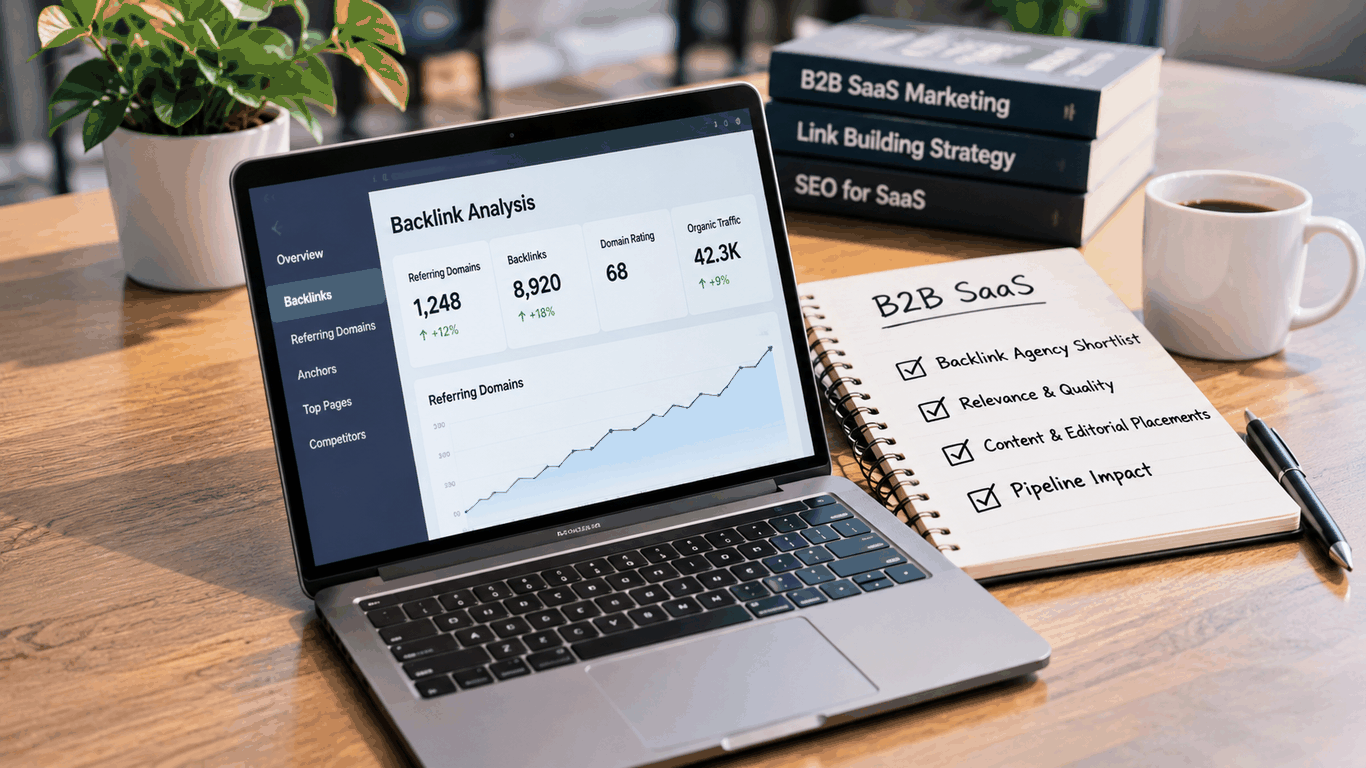
Most software marketing leaders have burned budget on at least one generic link vendor. Buying bulk guest posts on multi-niche blogs feels like renting highway billboards for enterprise DevOps software: impressions rise on a monthly spreadsheet, yet zero qualified buyers book a demo. Hiring a specialized B2B SaaS backlink agency only pays off when the partner prioritizes buyer-relevant editorial mentions over raw link volume, ties work directly to commercial product pages, and measures pipeline alongside clear payback assumptions.
“In B2B SaaS, acquiring 5 contextual editorial mentions on trade publications read by actual technical buyers delivers far more enterprise pipeline than 50 generic links placed across irrelevant multi-niche blogs.”
Table of Contents
- 1. Why Generic Link Vendors Fail B2B Software Teams
- 2. Google Rankings vs. AI Citations: What Is Proven and What Is Not
- 3. Relevance First: A Better Way to Vet Publishers
- 4. Paid-Link Risk, Link Velocity, and Google Spam Policies
- 5. Agency vs. In-House vs. Freelancer vs. DIY PR
- 6. A Transparent 24-Month Payback Model (Illustrative Only)
- 7. Conclusion & Actionable Next Steps
- 8. Frequently Asked Questions About Hiring a SaaS Backlink Agency
1. Why Generic Link Vendors Fail B2B Software Teams
Traditional software backlink services built for local businesses or affiliate blogs usually chase cheap links just to push up a third-party domain score. In B2B software, three fundamental industry shifts break that outdated approach:
Links Point to Wrong Pages
Low-cost vendors rarely earn mentions for /pricing, /integrations, or competitor comparison pages. Instead, they dump links onto generic top-of-funnel glossary posts that never convert software buyers.
Buyers Shortlist via AI First
According to G2's April 2026 Answer Economy report (surveying 1,076 B2B software buyers), 51% of buyers start research with an AI chatbot more often than Google, 69% were led to choose an unexpected vendor, and 33% bought from a vendor they had never heard of before.
Strict Committee Due Diligence
Security reviewers, engineering leads, and CFOs inspect vendor credibility across independent trade media and peer review hubs. A backlink hidden on a multi-topic 'write for us' farm helps neither search conversion nor enterprise trust.
2. Google Rankings vs. AI Citations: What Is Proven and What Is Not
Software founders often get pitched "AI SEO" by aggressive agencies claiming backlinks automatically force ChatGPT or Perplexity to recommend a product. That claim goes beyond the empirical evidence.
How Google Evaluates Links
Google Search relies heavily on link graph signals alongside content quality and page relevance. When trusted industry sites link naturally to your product guides, integrations, or comparison pages, those commercial landing pages compete significantly better in organic rankings.
How AI Answer Engines Cite Sources
AI chatbots (ChatGPT, Perplexity, Gemini) do not run Google's PageRank algorithm, and their answers are probabilistic rather than fixed. Direct proof that backlinks by themselves cause AI citations remains limited. Live AI assistants primarily pull from structured review platforms, comparison roundups, and authoritative trade articles where your product is accurately described.
Focused editorial link acquisition supports Google rankings directly today while placing clear third-party product information on the exact publications that human buyers and AI research bots read.
3. Relevance First: A Better Way to Vet Publishers
Many agencies enforce rigid numeric gates such as "DR 50+ and 5,000+ monthly traffic" on every target site. That rule creates a major blind spot: Domain Rating (DR) is a proprietary Ahrefs score, not a Google ranking signal. Strict DR cutoffs routinely reject genuine, niche B2B newsletters and security or fintech trade blogs that your actual buyers read every week, simply because those focused publications have smaller overall link profiles.
At Metalynks, we enforce a three-step, relevance-first filter instead:
1. Audience Fit First: Do engineers, finance leaders, RevOps managers, or security buyers in your target market actually read this publication?
2. Editorial Standards Second: Are articles written and edited by real practitioners for real readers, or does the site publish unrelated paid posts on crypto, casino, plumbing, and SaaS side by side?
3. Domain Metrics Third (Sanity Check Only): Use traffic estimates and third-party DR/DA scores only to spot dead or penalized domains, never as the main reason to accept or reject an authentic industry publication.
4. Paid-Link Risk, Link Velocity, and Google Spam Policies
Google's spam policies explicitly treat buying or selling links to manipulate search rankings as a link scheme violation. If a vendor sells guaranteed placements on hidden publisher spreadsheets or suddenly pushes 40 exact-match commercial links in a single month (an unnatural spike in link velocity), those links risk getting ignored algorithmically by SpamBrain or triggering manual ranking drops.
When you plan to hire a SaaS link builder, ask plainly how placements are earned without paying publishers for links:
- Targeted Digital PR and Original Data: Packaging anonymized product benchmarks or industry surveys that journalists genuinely cite. An April 2025 analysis of 31 million outreach emails and 86,000 campaigns by BuzzStream found that focused outreach batches of 51 to 100 emails averaged 12.08 earned links per campaign, whereas bulk "spray and pray" blasts of 1,001 to 5,000 emails earned roughly 70% fewer links per campaign.
- Subject-Matter Expert Commentary: Helping your founders, CTO, or product leads provide quick expert quotes for reporters writing software stories.
- Ecosystem & Integration Co-Marketing: Building joint technical guides, partner directories, and integration pages with complementary non-competing software platforms.
- Comparison & Review Ecosystems: Keeping profiles updated on G2, Capterra, and industry review lists where editors verify active software products cleanly.
5. Agency vs. In-House vs. Freelancer vs. DIY PR
An external agency is not always the smartest first hire. Compare the four realistic ways B2B SaaS teams build off-page authority:
Note: Agency pricing above reflects typical retainer ranges observed across white-hat B2B SaaS specialists (often equating to $350 – $1,500+ per earned editorial link depending on publication tier and asset creation), rather than an audited market survey.
6. A Transparent 24-Month Payback Model (Illustrative Only)
Many vendor pitches overpromise fast ROI by omitting content production costs, realistic sales CAC, early customer churn, and ongoing retainer spend. Below is an illustrative budgeting model built around two scenarios: a strong base ramp and a slower conservative ramp.
Explicit Base-Case Financial Assumptions:
- All-In Monthly SEO Spend: $6,500/month ($5,500/mo link agency retainer plus $1,000/mo internal/freelance content and data-asset production), continuing past Year 1 so rankings hold.
- Average Contract Value: $1,000 MRR per closed SaaS customer ($12,000/year ACV).
- Gross Margin: 80% ($800 monthly gross profit per active account).
- Non-SEO Sales & Onboarding CAC: $2,000 one-time per closed deal (~2 months of ACV).
- Logo Churn: 1% per month applied starting Month 6 across active cohorts (~11.4% annualized).
- Base Deal Ramp: Zero closed deals in Months 1–4; ramping from 1 deal in Month 5 to 3 deals/month by Month 10 (17 deals in Year 1, continuing at 3 deals/month in Year 2). (Attributing 17 deals purely to links assumes strong existing product pages and market demand.)
Base Case Payback Timeline
Under steady Year-2 additions (3 deals/mo, 1% monthly churn, continuing $6,500/mo spend), cumulative net cash flow turns positive around Month 19 (+$4,780).
Conservative Case Payback Timeline
If conversion velocity runs at roughly half the Year-1 pace (9 deals in Year 1, scaling to 2 deals/month in Year 2 under the same costs and 1% churn), cumulative breakeven stretches to Month 24 (+$1,648).
To stress-test your own ACV and margins, copy those nine columns into Google Sheets or Excel and run both your expected and half-pace scenarios before locking into a long contract.
7. Conclusion & Actionable Next Steps
Choosing a B2B SaaS backlink agency works best when you treat off-page authority as targeted editorial outreach tied directly to commercial pages rather than buying bulk link volume.
As an immediate next step this week, export your last 20 acquired backlinks into a spreadsheet, tag whether each publication reaches real B2B buyers, and check inside GA4 whether any of the target URLs generated assisted demo conversions. That single audit will tell you whether you need a stronger link partner, cleaner conversion pages, or in-house PR before committing another quarter of budget.
8. Frequently Asked Questions About Hiring a SaaS Backlink Agency

Written by Pratik Parmar
Founder & Principal SEO Strategist at Metalynks
Specializing in high-DR editorial link building, forensic toxic backlink disavowals, and Generative Engine Optimization (GEO) architectures for global SaaS enterprises.
Recommended Next Read
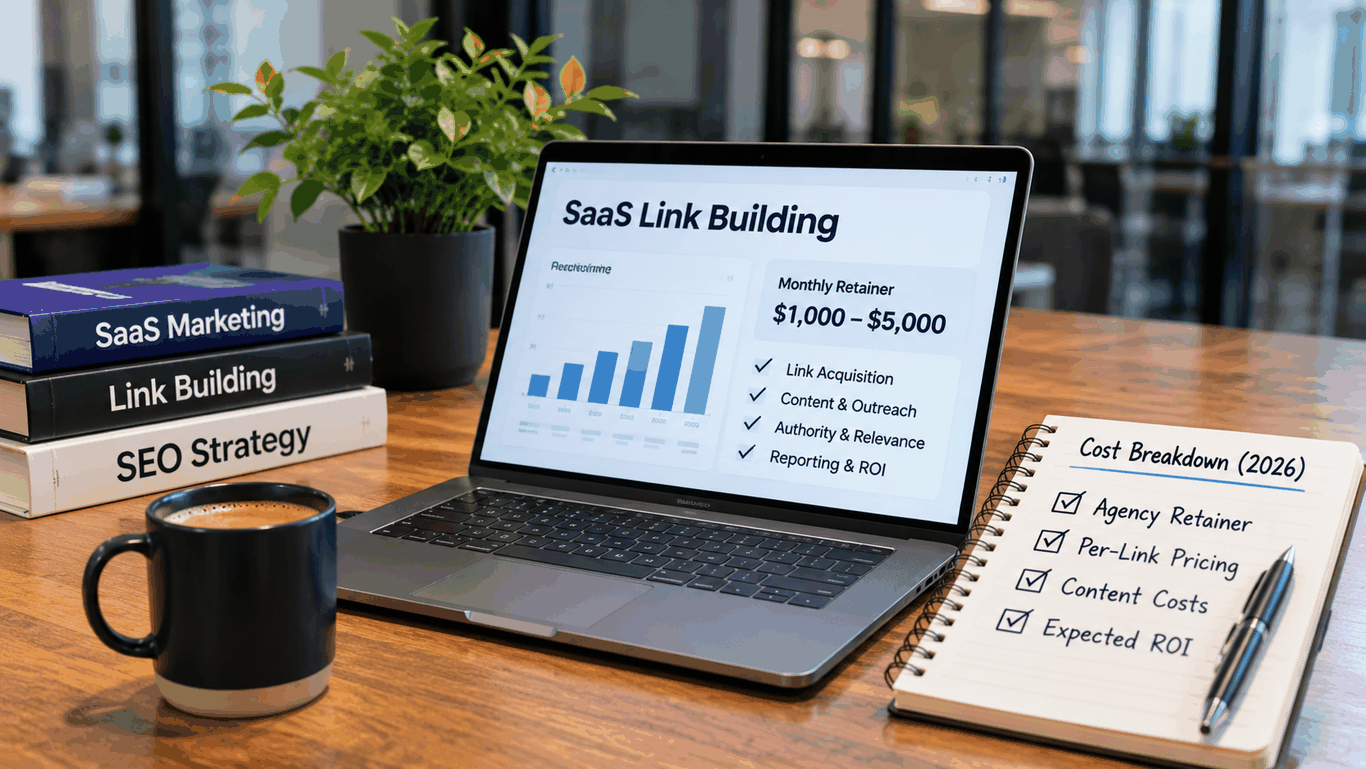
What Is the Cost of SaaS Link Building in 2026? (Agency Retainer Breakdown)
A realistic look at monthly retainers, cost per placement, and quality tiers for B2B SaaS link acquisition campaigns.